

Affiliate Disclosure: This article contains affiliate links to products I personally use and recommend. If you purchase through these links, I earn a small commission at no extra cost to you. This helps support The Cloud Standard and allows me to keep creating in-depth technical content.
⚡ Quick Summary: Sovereign cloud ensures your data is governed by your jurisdiction’s laws —
not a foreign government’s. This guide covers the 3 pillars of sovereign cloud (data, operational, and model
sovereignty), the geopatriation trend, a decision framework for what to repatriate, and a practical
implementation guide for enterprises and SMBs.
In 2026, the US CLOUD Act, the EU’s NIS2 Directive, and China’s Data Security Law have created three incompatible legal regimes for cloud data. A company operating across all three jurisdictions cannot fully comply with all three simultaneously using a single hyperscaler. Something has to give.
According to Gartner, 75% of organizations will have adopted a digital sovereignty strategy by 2027 (Gartner, 2025). The question is no longer whether to think about data sovereignty, but how to implement it without breaking your existing cloud infrastructure.
This guide gives you the framework to answer that question.
Table of Contents
- What is sovereign cloud?
- The 3 pillars of sovereign cloud in 2026
- The rise of geopatriation
- Decision framework: what should you geopatriate?
- Sovereign cloud providers: Europe & beyond
- Implementation: sovereignty for everyone
- Sovereign cloud compliance checklist
- The future: sovereign AI and safe intelligence
- Frequently asked questions
- Conclusion
What is sovereign cloud? (And why “residency” isn’t enough)
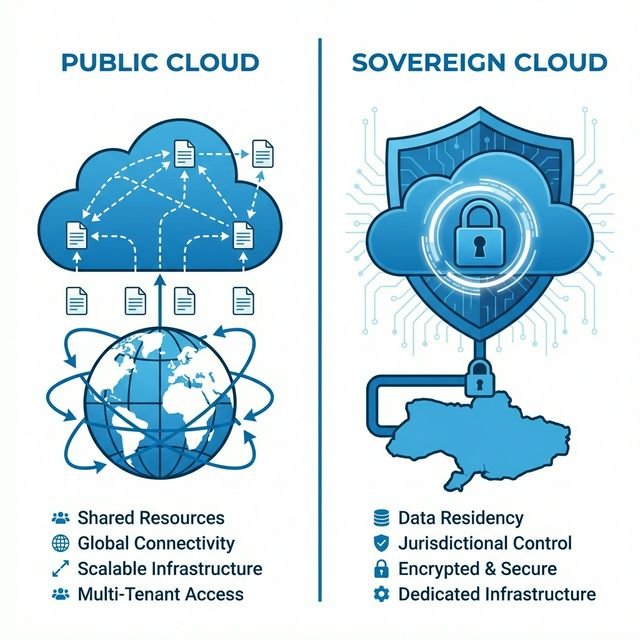
Sovereign cloud is a cloud environment where data access, operations, and legal jurisdiction are wholly confined within a single national boundary, protected from foreign access requests. Unlike standard data residency, true sovereign cloud ensures that no foreign entity — legal or operational — can compel access to your data.
The vital distinction: You can have residency without sovereignty. If your data is in a Paris datacenter but managed by a US hyperscaler, it is resident in France but may still be subject to US subpoenas under the CLOUD Act. True sovereign cloud ensures that no foreign entity — legal or operational — can compel access to your data.
This distinction matters enormously for regulated industries. A French hospital storing patient records on AWS eu-west-3 (Paris) has data residency. But AWS is a US company. Under the CLOUD Act, a US court can compel AWS to produce that data regardless of where it’s physically stored. That hospital does not have data sovereignty.
The 3 pillars of sovereign cloud in 2026
A comprehensive sovereign cloud strategy rests on three pillars: data sovereignty (jurisdictional legal control over stored data), operational sovereignty (preventing unauthorized foreign access to systems and personnel), and model sovereignty (ensuring proprietary AI training data and model weights remain within national borders).
1. Data sovereignty (jurisdictional control)
Data sovereignty means the laws of your country — not a foreign government’s — govern who can access your stored data. It requires that both the physical infrastructure and the legal entity operating it fall under your jurisdiction’s law.
This pillar covers your databases, object storage, and backups. The key requirement: the cloud provider must be incorporated under your jurisdiction’s law, not just operating a datacenter there. A US company with a French datacenter does not satisfy data sovereignty for EU regulated industries.
Regulations driving this: GDPR Article 46, NIS2 Directive, EU Data Act, France’s SecNumCloud certification, Germany’s C5 standard.
2. Operational sovereignty (no foreign access)
Operational sovereignty means that foreign nationals — including the cloud provider’s own engineers — cannot access your systems without your explicit authorization. This goes beyond data location to cover who can touch your infrastructure.
This is where most “sovereign cloud” offerings from hyperscalers fall short. AWS GovCloud and Azure Government are US-only, but they still involve US-based personnel. For EU sovereign cloud, you need providers where all operational staff are EU citizens operating under EU law.
Implementation tools: Customer-managed encryption keys (CMEK), hardware security modules (HSMs), access logging with immutable audit trails, and contractual restrictions on personnel nationality.
3. Model sovereignty (the AI factor)
Model sovereignty is the newest and most strategically critical pillar: ensuring that your proprietary AI training data, fine-tuned model weights, and inference infrastructure remain within your jurisdiction and cannot be accessed or replicated by foreign entities.
This is the pillar that most 2025-era sovereign cloud frameworks missed. As organizations train proprietary models on sensitive data — patient records, legal documents, financial transactions — the model itself becomes a compressed representation of that data. A model trained on your data, if accessed by a foreign entity, is effectively a data breach.
The EU AI Act (effective August 2024) and proposed US AI legislation both touch on this. Expect model sovereignty to become a formal regulatory requirement by 2027.
The rise of geopatriation
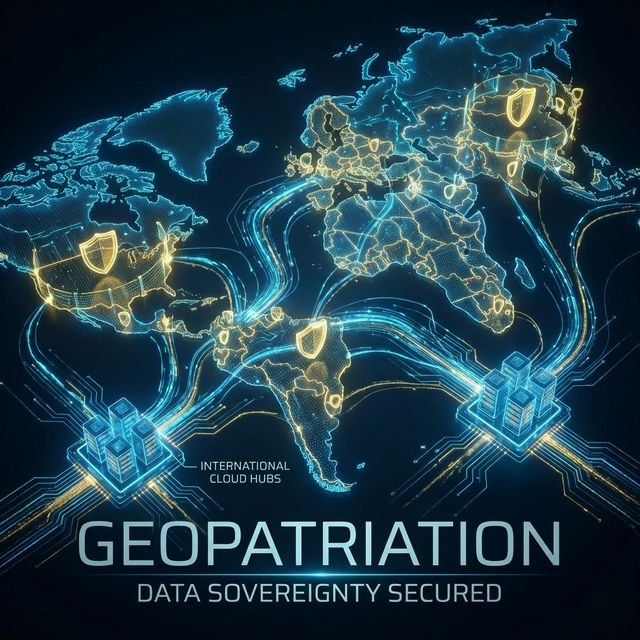
Geopatriation is the deliberate repatriation of data and workloads from foreign-controlled cloud providers to sovereign or domestic infrastructure. It is the reverse of cloud migration: instead of moving data to the cloud, you move it back to jurisdictionally controlled environments.
The term is new but the trend is not. European governments have been quietly repatriating sensitive workloads since the Schrems II ruling in 2020, which invalidated the EU-US Privacy Shield and created legal uncertainty for transatlantic data transfers.
What changed in 2025-2026 is the scale. According to Fortune Business Insights (2024), the sovereign cloud market is projected to reach $137.6 billion by 2030, growing at a 26.7% CAGR. This is no longer a niche compliance exercise — it is a major infrastructure shift.
Three regulatory developments are driving the acceleration:
- The EU Data Act (2025): Requires that cloud switching be technically feasible and that data
can be moved to a different provider within 30 days. This makes geopatriation operationally viable for the
first time. - NIS2 Directive (enforced 2024): Extends cybersecurity requirements to 18 critical sectors
and explicitly addresses supply chain risk — including cloud provider nationality. - US CLOUD Act enforcement: Several high-profile cases in 2024-2025 where US authorities
successfully compelled US cloud providers to produce data stored in EU datacenters have accelerated European
geopatriation decisions.
Does this mean you need to leave the public cloud entirely? No. The future is hybrid sovereign: sensitive data on sovereign infrastructure, commodity workloads on hyperscalers, with clear data classification policies governing which data goes where.
Decision framework: what should you geopatriate?
Not all data requires sovereign treatment. Use a three-tier classification: Tier 1 (regulated/sensitive data requiring sovereign cloud), Tier 2 (internal operational data suitable for EU-controlled cloud), and Tier 3 (public or commodity data that can remain on any hyperscaler).
| Data Type | Sovereignty Requirement | Recommended Approach |
|---|---|---|
| Patient records, legal documents, financial data | 🔴 High — Tier 1 | Sovereign cloud provider (OVHcloud, Hetzner, Exoscale) |
| Internal communications, HR data, IP | 🟡 Medium — Tier 2 | EU-controlled cloud (Proton, Infomaniak) or on-prem |
| Public website, CDN assets, marketing data | 🟢 Low — Tier 3 | Any hyperscaler (AWS, Azure, GCP) |
| AI training data and model weights | 🔴 High — Tier 1 | Sovereign GPU infrastructure or on-prem |
| Backup and disaster recovery | 🟡 Medium — Tier 2 | EU-controlled cloud with encryption at rest |
The practical question is: what would happen if a US court ordered your cloud provider to hand over this data? If the answer is “serious regulatory, legal, or competitive harm,” it belongs in Tier 1.
Sovereign cloud providers: Europe & beyond
The European sovereign cloud market has matured significantly. Leading providers include OVHcloud (France), Hetzner (Germany), Exoscale (Switzerland), and Infomaniak (Switzerland). For personal and SMB sovereignty, Proton’s Swiss-based encrypted suite offers the most accessible entry point. The Gaia-X initiative provides a federated framework connecting multiple European providers.
OVHcloud (France)
OVHcloud is Europe’s largest cloud provider by infrastructure, with 43 datacenters across 4 continents. It is incorporated under French law and operates under EU jurisdiction. OVHcloud holds France’s SecNumCloud certification — the most stringent sovereign cloud standard in Europe — for its Hosted Private Cloud offering.
OVHcloud is the right choice for enterprises that need SecNumCloud certification, French public sector compliance, or EU-only operational staff. The managed services are less mature than AWS or Azure — the Kubernetes offering (OVHcloud Managed Kubernetes) is solid, but don’t expect EKS-level ecosystem depth.
Hetzner (Germany)
Hetzner is a German-incorporated provider with datacenters in Germany and Finland. It is widely used by European developers and startups for its aggressive pricing — dedicated servers and cloud VMs at 30-50% below AWS equivalent pricing. Hetzner operates under German law (BDSG) and EU GDPR.
Hetzner is a good fit for cost-sensitive workloads, developer infrastructure, and startups that need EU sovereignty without enterprise pricing. It is not suitable for organizations requiring formal sovereign cloud certifications, and it has limited managed services with no AI/ML infrastructure.
Exoscale (Switzerland)
Exoscale is a Swiss cloud provider operating exclusively in Switzerland and Austria. Swiss law provides some of the strongest data protection in the world — Switzerland is not an EU member and is not subject to EU court jurisdiction, but its Federal Act on Data Protection (nFADP) aligns closely with GDPR while adding additional protections.
Exoscale is best for financial services, healthcare, and organizations that specifically need Swiss jurisdiction — outside both EU and US legal reach. Note that it has a narrower service catalog than the major hyperscalers.
Proton (Switzerland) — for SMBs and individuals
For businesses that don’t need enterprise cloud infrastructure but do need sovereign email, storage, and communications, Proton’s Business Suite is the most accessible sovereign cloud option available. Based in Geneva, Switzerland, Proton operates under Swiss law with zero-access encryption — even Proton cannot read your data.
For a full migration guide from Google Workspace to Proton, see our Privacy-First Cloud Stack guide.
Gaia-X: the federated approach
Gaia-X is not a cloud provider — it is a European framework for federated, interoperable cloud infrastructure. Think of it as a standards body and certification scheme that allows multiple European providers to offer interoperable services under a common sovereignty framework.
The French government’s DINUM (Interministerial Digital Directorate) has adopted Gaia-X principles for its “cloud souverain” strategy, requiring that sensitive government workloads run on SecNumCloud-certified providers. By 2025, over 300 organizations had joined the Gaia-X Association, including Deutsche Telekom, Orange, and Siemens.
Gaia-X is most relevant for large enterprises and public sector organizations that need to demonstrate compliance with EU sovereignty requirements through a recognized framework.
Implementation: sovereignty for everyone (not just enterprises)
Implementing sovereign cloud doesn’t require a full infrastructure overhaul. Start with data classification, then migrate Tier 1 data to a sovereign provider while keeping commodity workloads on hyperscalers. For SMBs, switching email and file storage to a Swiss-based provider like Proton achieves meaningful sovereignty in under 48 hours.
For enterprises: the hybrid sovereign architecture
The practical enterprise approach is a tiered architecture. For an in-depth guide on implementing hybrid cloud patterns and the tooling that makes it work, see our Hybrid Multi-Cloud Architecture: 2026 Enterprise Playbook.
- Classify your data using the Tier 1/2/3 framework above. This is the hardest step and
typically takes 4-8 weeks for a mid-size enterprise. - Migrate Tier 1 data to a sovereign provider. For EU organizations, OVHcloud or Exoscale
are the most mature options. For AI workloads, consider on-premises GPU infrastructure. - Implement customer-managed encryption keys (CMEK) for any Tier 2 data remaining on
hyperscalers. This doesn’t achieve full sovereignty but significantly limits exposure. - Establish contractual sovereignty — ensure your cloud contracts explicitly restrict
personnel access by nationality and require notification of any government access requests. - Build a data portability layer using open standards (S3-compatible APIs, Kubernetes) so
you can move workloads between providers without rewriting applications.
For SMBs: the Proton stack
For businesses without dedicated infrastructure teams, the fastest path to meaningful sovereignty is the Proton Business Suite. It covers email, calendar, file storage, VPN, and password management — all under Swiss law with zero-access encryption.
This won’t satisfy SecNumCloud certification requirements, but it removes your most sensitive business communications from US CLOUD Act jurisdiction in under 48 hours. For most SMBs, that’s the right trade-off. See our Privacy-First Cloud Stack guide for the full migration walkthrough.
Sovereign cloud compliance checklist
Use this checklist to assess your current sovereign cloud posture. Each item maps to a specific regulatory requirement or operational sovereignty control.
| Control | Requirement | Status |
|---|---|---|
| Data classification policy | Tier 1/2/3 classification for all data types | ☐ Not started / ☐ In progress / ☐ Complete |
| Provider jurisdiction | Tier 1 data on provider incorporated under your jurisdiction | ☐ Not started / ☐ In progress / ☐ Complete |
| Customer-managed encryption keys | CMEK implemented for all Tier 1 and Tier 2 data | ☐ Not started / ☐ In progress / ☐ Complete |
| Personnel access controls | Contractual restriction on foreign national access to Tier 1 systems | ☐ Not started / ☐ In progress / ☐ Complete |
| Government access notification | Provider contractually required to notify you of government access requests | ☐ Not started / ☐ In progress / ☐ Complete |
| Data portability | Ability to export and migrate all data within 30 days (EU Data Act) | ☐ Not started / ☐ In progress / ☐ Complete |
| AI/model sovereignty | Training data and model weights stored on sovereign infrastructure | ☐ Not started / ☐ In progress / ☐ Complete |
| Audit logging | Immutable audit trail for all access to Tier 1 data | ☐ Not started / ☐ In progress / ☐ Complete |
| Incident response | Sovereign cloud-specific incident response plan documented | ☐ Not started / ☐ In progress / ☐ Complete |
| Certification | Provider holds relevant certification (SecNumCloud, C5, ISO 27001) | ☐ Not started / ☐ In progress / ☐ Complete |
The future: sovereign AI and safe intelligence
Sovereign AI — running AI inference and training on jurisdictionally controlled infrastructure — is the next frontier of data sovereignty. As organizations fine-tune large language models on proprietary data, the model itself becomes a sovereignty concern. Expect sovereign AI requirements to appear in regulated industry frameworks by 2027.
The sovereign cloud conversation in 2024 was about data. In 2026, it’s about models.
When a hospital fine-tunes an LLM on patient records to build a clinical decision support tool, that model is a compressed representation of those records. If the model is stored on a US cloud provider, it is subject to the same CLOUD Act exposure as the underlying data.
Several European providers are building sovereign AI infrastructure in response:
- Mistral AI (France) — Open-weight models that can be deployed on-premises or on sovereign
EU infrastructure, avoiding US model dependency - Aleph Alpha (Germany) — Enterprise LLMs designed specifically for European sovereign
deployment, with full model transparency - OVHcloud AI Deploy — Sovereign GPU infrastructure for model training and inference,
SecNumCloud-eligible
For organizations building AI products on sensitive data, sovereign AI infrastructure is no longer optional — it is the only defensible architecture for regulated industries.
Conclusion: sovereignty is a data strategy, not a compliance checkbox
The organizations that treat sovereign cloud as a compliance exercise will spend money and gain little. The ones that treat it as a data strategy will gain competitive advantage: client trust, regulatory resilience, and protection of their most valuable asset — their data and their models.
Start with the compliance checklist above. Classify your data. Pick one Tier 1 asset and move it — whether that’s migrating business email to a Swiss provider this weekend, or scheduling a database migration to an EU-incorporated cloud next quarter. Sovereignty is built incrementally, not by a single migration project.
You know where your data lives. Now make sure you know who owns the laws that govern it. Then act on it.
What is sovereign cloud?
Sovereign cloud is a cloud environment where data access, operations, and legal jurisdiction are wholly confined within a single national boundary, protected from foreign access requests. Unlike standard data residency, sovereign cloud ensures no foreign entity — legal or operational — can compel access to your data.
What is the difference between data residency and data sovereignty?
Data residency means your data is physically stored in a specific country. Data sovereignty means the laws of that country govern access to your data. You can have residency without sovereignty: if your data is in a Paris datacenter managed by a US company, it is resident in France but may still be subject to US subpoenas under the CLOUD Act.
What is geopatriation?
Geopatriation is the deliberate repatriation of data and workloads from foreign-controlled cloud providers to sovereign or domestic infrastructure. It is the reverse of cloud migration: instead of moving data to the cloud, you move it back to jurisdictionally controlled environments.
What is the US CLOUD Act and how does it affect cloud data?
The US CLOUD Act (2018) allows US law enforcement to compel US-based cloud providers to hand over data stored anywhere in the world, regardless of where the data physically resides. This means data stored in a European datacenter operated by AWS, Microsoft Azure, or Google Cloud can still be accessed by US authorities under a valid CLOUD Act order.
What are examples of sovereign cloud providers in Europe?
Leading European sovereign cloud providers include OVHcloud (France), Hetzner (Germany), Exoscale (Switzerland), and Proton Drive (Switzerland). The Gaia-X initiative is a European framework for federated, sovereign cloud infrastructure. For AI workloads, Mistral AI (France) offers sovereign large language models.