


12 min read
By the end of 2026, nearly 40% of enterprise applications will have AI agents embedded—up from just 5% in 2025. This isn’t a prediction; it’s already happening.
If you’ve been watching from the sidelines, wondering whether AI agents are hype or substance, this is your signal: the enterprise world has moved past experimentation. Organizations aren’t just piloting AI agents anymore—57% already have them running in production.
What is an AI agent? An AI agent is an autonomous software system that perceives its environment, makes decisions, and executes complex tasks without continuous human oversight. Unlike chatbots, AI agents don’t just respond—they act.
In this comprehensive guide, you’ll learn:
- What Are AI Agents? A Clear Definition
- Why 2026 Is the Breakthrough Year for Enterprise AI Agents
- AI Agents vs Chatbots vs RPA: What’s the Difference?
- Enterprise Use Cases for AI Agents in 2026
- How to Deploy AI Agents in Your Enterprise
- The Future of AI Agents in the Enterprise
- Security and Ethics
- Frequently Asked Questions
- What’s Next?
Let’s dive in.
What Are AI Agents? A Clear Definition
An AI agent is autonomous software that can:
- Perceive its environment by collecting data from various sources
- Reason about that information using large language models (LLMs) and domain knowledge
- Plan multi-step actions to achieve goals
- Act by executing tasks, calling APIs, or triggering workflows
- Learn from outcomes to improve future performance
The key distinction from traditional software—and even from ChatGPT-style interfaces—is autonomy. You give an AI agent a goal; it figures out how to achieve it.
The Architecture of an AI Agent
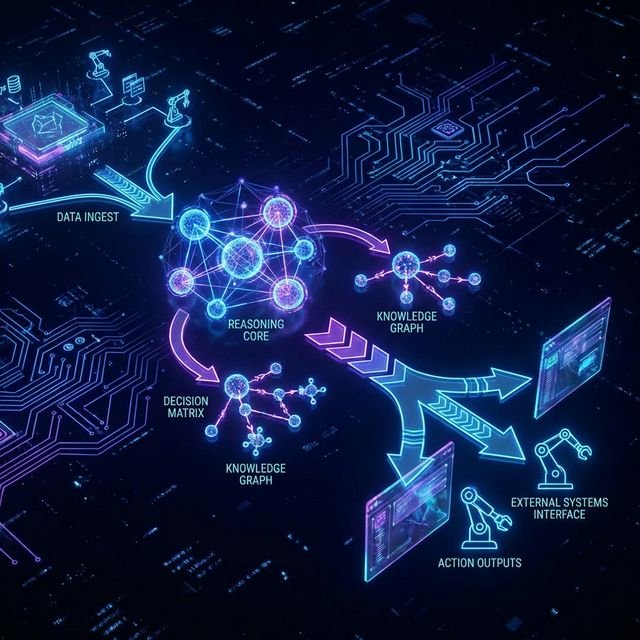
Architecture diagram showing how AI agents perceive data, reason about it, plan actions, and execute through various tools with continuous feedback loops.
How this differs from a basic LLM:
| Capability | Basic LLM (ChatGPT) | AI Agent |
|---|---|---|
| Responds to queries | ✅ | ✅ |
| Remembers context across sessions | ❌ | ✅ |
| Takes real-world actions | ❌ | ✅ |
| Uses external tools | Limited | ✅ |
| Learns from outcomes | ❌ | ✅ |
| Operates autonomously | ❌ | ✅ |
Think of it this way: ChatGPT answers questions. AI agents complete missions.
Why 2026 Is the Breakthrough Year for Enterprise AI Agents
We’ve reached an inflection point. The technology has matured, the ROI is proven, and the market is exploding.
The Numbers Tell the Story
| Metric | 2025 | 2026 Projection | Change |
|---|---|---|---|
| Enterprise apps with AI agents | ~5% | ~40% | +700% |
| Organizations with agents in production | 20% | 57%+ | +185% |
| Market size | $7.84B | $11.5B | +47% |
| Autonomous work decisions by AI | Minimal | 15% | — |
Sources: Gartner, G2, Forrester, Industry Reports

The AI agent market is projected to grow from $7.84 billion in 2025 to $52.62 billion by 2030—a compound annual growth rate of 46.3%.
What’s Driving This Acceleration?
1. Generative AI has matured. The foundation models (GPT-4, Claude, Gemini) are now production-ready. Enterprises trust them for mission-critical tasks.
2. Multi-agent orchestration works. We’ve moved beyond single-purpose bots to coordinated teams of specialized agents working together on complex workflows.
3. ROI is proven. Early adopters have published results. Back-office automation alone is delivering 40-60% cost reductions in document processing and compliance workflows.
4. Regulatory frameworks are catching up. The EU AI Act provides clarity. Enterprises can now invest with confidence in governance models.
5. The infrastructure exists. Platforms like Microsoft Copilot Studio, Salesforce Agentforce, and AWS Bedrock Agents make deployment accessible without building from scratch.
AI Agents vs Chatbots vs RPA: What’s the Difference?
This is one of the most common questions—and one of the most misunderstood. Let’s clear it up.
The Comparison Matrix
| Capability | RPA | Chatbots | AI Agents |
|---|---|---|---|
| Autonomy | None (rule-based) | Limited (scripted) | High (goal-driven) |
| Data Handling | Structured only | Natural language | Structured + unstructured |
| Learning | Cannot learn | Requires manual updates | Self-improving |
| Decision Making | Follows scripts exactly | Predefined responses | Autonomous reasoning |
| Adaptability | Breaks if process changes | Needs reprogramming | Adapts automatically |
| Best For | Repetitive, predictable tasks | Customer support queries | Complex, variable workflows |
A Simple Mental Model
Think of RPA as your hands, chatbots as your voice, and AI agents as your brain.
RPA excels at high-volume, repetitive tasks with predictable inputs: data entry, file transfers, form filling. It’s fast and reliable—but brittle. Change the UI, and it breaks.
Chatbots handle conversations. They’re great for answering FAQs, routing support tickets, and providing information. But they struggle with anything outside their script.
AI agents understand context, make decisions, and adapt. They can handle the unexpected. Givethem a goal—”reconcile these invoices” or “onboard this new employee”—and they figure out how.
When to Use Each
| Use Case | Best Tool |
|---|---|
| Processing 10,000 identical forms daily | RPA |
| Answering customer FAQs 24/7 | Chatbot |
| Coordinating a multi-step approval workflow with exceptions | AI Agent |
| Migrating data between systems on a schedule | RPA |
| Qualifying sales leads based on conversation context | AI Agent |
| Providing first-line IT support | Chatbot → AI Agent escalation |
Enterprise Use Cases for AI Agents in 2026
Let’s move from theory to practice. Where are AI agents delivering real value today?
Back-Office Automation (Highest ROI)
This is where the money is. Back-office processes are often:
- High volume
- Document-heavy
- Exception-prone
- Expensive when done manually
AI agents excel here because they can handle the variability that breaks RPA.
Examples:
- Invoice processing and reconciliation: Agents extract data from invoices (PDFs, emails, scanned documents), match them against purchase orders, flag discrepancies, and route for approval
- Compliance monitoring: Continuous scanning of processes against regulatory requirements, with automated reporting and exception alerts
- Contract analysis: Extracting key terms, identifying risks, and summarizing obligations across thousands of documents
Organizations in healthcare must pay particular attention to compliance requirements for healthcare when deploying AI agents that handle sensitive data.
IT Operations and Incident Management
IT teams are overwhelmed. AI agents are becoming force multipliers.
Examples:
- Automated triage and resolution: Agents classify incoming tickets, attempt first-pass resolution, and escalate only what requires human judgment
- Predictive maintenance: Analyzing system logs and metrics to predict failures before they impact users
- Infrastructure monitoring: Continuous observation with automated responses to defined conditions
Sales and Revenue Operations
Sales teams spend too much time on administration and not enough on selling. AI agents are changing that equation.
Examples:
- Lead qualification and scoring: Agents analyze prospect data, engagement signals, and firmographic information to prioritize leads
- Automated follow-ups: Personalized outreach based on prospect behavior and conversation history
- Pipeline forecasting: Aggregating data across deals to provide accurate revenue predictions
For agencies managing multiple clients, combining AI agents with proper team credential management creates secure, scalable workflows.
Supply Chain and Logistics
Global supply chains are complex. AI agents provide visibility and responsiveness.
Examples:
- Real-time inventory optimization: Balancing stock levels across locations based on demand signals
- Demand forecasting: Predicting future needs using historical data, market trends, and external signals
- Supplier risk monitoring: Tracking supplier health indicators and flagging potential disruptions
Multi-Agent Collaboration
The most powerful implementations don’t use a single agent—they orchestrate multiple specialized agents working together.
In this model, the Orchestrator Agent breaks complex goals into subtasks and delegates them to specialized agents. Each specialist handles its domain, but they share context through a common memory store—enabling true collaboration.
How to Deploy AI Agents in Your Enterprise
Ready to move from reading to doing? Here’s a practical framework.
Step 1: Identify High-Impact Use Cases
Not every process needs an AI agent. Start where the impact is highest:
Ideal candidates:
- High volume (1,000+ instances per month)
- Multi-step with decision points
- Currently requires skilled human judgment
- Has clear success metrics
- Involves unstructured data (documents, emails, conversations)
Start with back-office automation. It consistently delivers the highest ROI with the lowest risk.
Step 2: Choose Your Platform Approach
You have three paths:
| Approach | Pros | Cons | Best For |
|---|---|---|---|
| Build custom | Full control, tailored to needs | High cost, long timeline, maintenance burden | Unique, differentiated use cases |
| Platform (low-code) | Faster deployment, vendor support | Less flexibility, platform lock-in | Most enterprise use cases |
| Hybrid | Balance of control and speed | Complexity in integration | Organizations with strong engineering teams |
Leading platforms in 2026:
- Microsoft Copilot Studio: Deep Office 365 integration, enterprise-ready
- Salesforce Agentforce: Native CRM integration, strong for sales/service
- AWS Bedrock Agents: Flexible, multi-model support, infrastructure control
- Google Vertex AI Agents: Strong reasoning capabilities, GCP integration
Step 3: Establish Governance and Guardrails
This is where many deployments fail. AI agents need clear boundaries.
Define decision authority levels:
- What can agents do autonomously?
- What requires human approval?
- What is off-limits entirely?
Create escalation protocols:
- When should agents hand off to humans?
- How quickly must humans respond?
- What happens if no human is available?
Implement audit logging:
- Every agent action must be logged
- Decisions must be explainable
- Logs must be tamper-proof
For organizations managing access at scale, implementing secure access revocation protocols becomes critical when AI agents have system access that must be managed as carefully as human access.
Step 4: Start Small, Scale Fast
The pattern that works:
- Pilot: 1-2 use cases, limited scope, 30-60 days
- Measure: Document ROI meticulously
- Learn: Identify what worked and what didn’t
- Expand: Apply learnings to next use case
- Scale: Build center of excellence, standardize patterns
Common mistake: Boiling the ocean. Don’t try to automate everything at once. Prove value, then expand.
The Future of AI Agents in the Enterprise
As we head into 2027 and beyond, AI agents will move from being standalone tools to becoming the primary interface for enterprise software. We are moving toward the “Agent-First Enterprise.”
In this future, you won’t log into a CRM to update a lead. You’ll tell your agent to handle it. You won’t navigate a complex ERP to run a report. Your agent will provide the insights you need, when you need them.
Security and Ethics
The rise of AI agents brings new challenges. How do we ensure they don’t hallucinate critical business decisions? How do we protect the data they access? How do we build trust in autonomous systems?
The answer lies in transparency, accountability, and rigorous testing. Organizations that prioritize these values will not only succeed in deploying AI agents but will also lead the way in defining the ethical future of AI.
Frequently Asked Questions
What is an AI agent?
An AI agent is an autonomous software system that perceives its environment, makes decisions, and executes complex tasks without continuous human oversight. Unlike traditional chatbots that simply respond to queries, AI agents can take real-world actions—calling APIs, updating databases, triggering workflows—to achieve specific goals.
How are AI agents different from chatbots?
Chatbots respond to queries using predefined scripts or knowledge bases. AI agents go further: they reason about problems, plan multi-step solutions, use external tools, learn from outcomes, and operate autonomously. Think of chatbots as your voice (communication), while AI agents are your brain (decision-making and action).
What’s the ROI of deploying AI agents?
Early adopters report 40-60% cost reductions in back-office processes like document processing and compliance workflows. The highest ROI typically comes from automating high-volume, exception-prone tasks that previously required skilled human judgment.
Are AI agents secure for enterprise use?
They can be—with proper governance. Key requirements include encryption, least-privilege access controls, comprehensive audit logging, and clear human oversight protocols. The EU AI Act, effective August 2026, mandates specific security and transparency requirements for high-risk AI systems.
How long does it take to deploy an AI agent?
Using modern platforms (Microsoft Copilot Studio, Salesforce Agentforce, AWS Bedrock Agents), a pilot deployment can be completed in 30-60 days. Custom-built solutions take longer—typically 3-6 months for production-ready implementations.
What’s Next?
The era of AI agents is not a distant future. It’s happening now. For enterprise leaders, the choice is clear: embrace the transformation or risk obsolescence.
The organizations that act now will define the next era of enterprise operations.
Related Reading:
- Password Manager With Legacy Contact: 3 Best Tools (2026 Guide)
- Managed WooCommerce Hosting: 5 Providers That Won’t Crash on Black Friday
- Best White Label Hosting for Agencies: Resell Under Your Own Brand